How the Duckworth-Lewis-Stern (DLS)Method Calculates Rain-Revised Targets
Duckworth-Lewis-Stern (DLS) Method is used to calculate rain-revised targets in cricket.Duckworth-Lewis-Stern (DLS) Method is used to calculate rain-revised targets in cricket. In the 1992 Cricket World Cup semi-final in Sydney, South Africa needed 22 runs off 13 balls against England when a 12-minute rain shower halted play. Under the “Most Productive Overs” rain rule used at the time, two overs werededucted alongside the runs England had scored in their two quietest overs (just 1 run), leaving South Africa a surreal target: 22 runs needed off 1 ball. That famous injustice proved that simple run-rate ratios and arbitrary over deductions were broken. English statisticians Frank Duckworth and Tony Lewis devised a mathematical solution first used internationally on January 1, 1997, adopted by the ICC in 1999, and updated in November 2014 by custodian Professor Steven Stern of Bond University to become the Duckworth-Lewis-Stern (DLS) method. Understanding the dls method in cricket comes down to one core principle: a batting side has two independent resources to score runs—not just overs remaining, but
also wickets in hand.
Why Simple “Average Run Rate” Fails in Rain-Interrupted Matches
Suppose Team 1 bats for all 50 overs, loses 9 wickets, and scores 250/9 (5.00 runs per over). If rain delays the chase so Team 2 only gets 20 overs, a naive Average Run Rate rule would ask Team 2 to score 101 in 20 overs with all 10 wickets in hand. That is heavily biased in favor of Team 2: batting 20 overs with 10 wickets intact allows T20-style aggression from Ball 1, whereas Team 1 had to pace its resources across 300 balls.
Combining Overs and Wickets Into a Single “Resource Percentage”
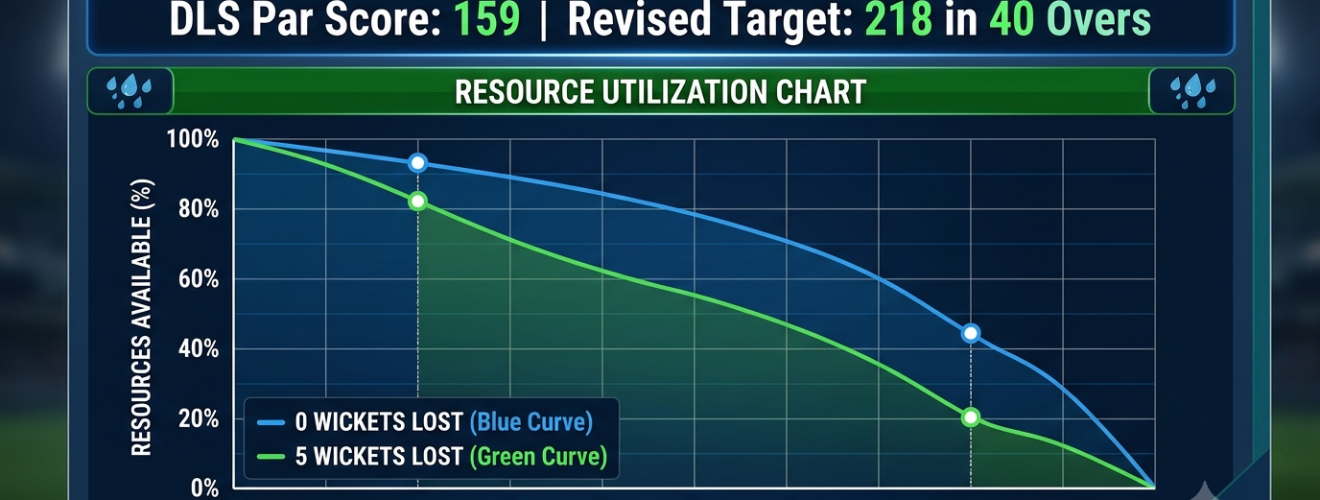
As set out in the ICC Duckworth-Lewis-Stern Methodology Regulations, the DLS model analyzes historical match data to express a team’s remaining scoring capacity at any point in an innings as a Resource Percentage based on Overs Remaining (u) and Wickets Lost (w). At the start of a 50-over innings (50 overs left, 0 wickets lost), a team has 100.0% of its resources. As overs are bowled and wickets fall, resources decay along an exponential curve: Z(u, w) = Z0(w) × [1 − exp(−b(w) · u)] Because losing wickets forces batters to rebuild and exposes tailenders early, losing wickets burns through resources much faster than losing early overs. Duckworth-Lewis-Stern
The Two DLS Target Formulas: Worked Step-by-Step Examples
Let S be Team 1’s final score, R1 be the resource percentage Team 1 had available, and R2 be the resource percentage available to Team 2. Under the DLS Standard Edition Rules, the revised target T is calculated as follows: Duckworth-Lewis-Stern
Case 1: Team 2 Has Fewer Resources Than Team 1 (R2 < R1)
When R2 < R1, Team 2’s par score scales proportionally to R2 / R1 (with decimals rounded down for the par score, plus 1 run for the winning target): Par Score = ⌊ S × (R2 / R1) ⌋ ⇒ Revised Target T = ⌊ S × (R2 / R1) ⌋ + 1Example A (Delayed Start to Chase): Team 1 scores 250 in 50 uninterrupted overs (S = 250, R1 = 100%). Rain reduces Team 2’s chase before it starts to 30 overs (0 wickets lost ⇒ R2 = 75.1%). Par Score = ⌊ 250 × (75.1 / 100) ⌋ = 187 ⇒ Target T = 188 runs in 30 overs. Example B (Rain Interruption Mid-Chase): Team 1 scores 250 in 50 overs (R1 = 100%). Team 2 reaches 40/1 after 12 overs when rain wipes out 10 overs (leaving 28 overs remaining out of a revised 40-over innings). At suspension (38 overs left, 1 wicket lost), Team 2 had 82.0% resources remaining; at resumption (28 overs left, 1 wicket lost), they have 68.8% remaining. The break cost Team 2 82.0% − 68.8% = 13.2%, so R2 = 100% − 13.2% = 86.8%. Revised Target T = ⌊ 250 × (86.8 / 100) ⌋ + 1 = 217 + 1 = 218 runs in 40 overs (needing 178 more runs from 28 overs).
Case 2: Team 2 Has More Resources Than Team 1 (R2 > R1)
Suppose Team 1 reaches 79/3 after 20 overs when rain reduces the match to 40 overs per side, and Team 1 finishes on 180 in 40 overs. At suspension (30 overs left, 3 wickets lost), Team 1 had 61.6% left; at resumption (20 overs left, 3 wickets lost), they had 49.1% left—losing 12.5% (R1 = 87.5%). Team 2, knowing from Ball 1 it is a 40-over game, starts with R2 = 89.3%. Because R2 > R1, the excess resource (1.8%) is multiplied by the average 50-over total (G50 = 245): Revised Target T = S + ⌊ G50 × (R2 − R1) / 100 ⌋ + 1 = 180 + ⌊ 245 × 0.018 ⌋ + 1 = 185 runs in 40 overs. In 2014, Professor Steven Stern’s DLS update (Bond University DLS Research) refined the high-scoring resource decay curves so that when teams score 350+ in ODIs or 220+ in T20s, the par score reflects modern boundary-hitting acceleration from the opening overs.
Conclusion
By pricing every over and every wicket on a unified resource table, the Duckworth-Lewis-Stern method turned rain- interrupted cricket into a fair mathematical contest where neither an ambushed first-innings batting side nor a shortened chasing team gets an unfair edge. Duckworth-Lewis-Stern
Frequently Asked Questions (FAQs)
What is the minimum number of overs required for a valid DLS result? Both teams must face at least 20 completed overs in an ODI and 5 completed overs in a standard T20I (or 10 overs in an ICC T20 World Cup knockout match) for a DLS result to stand, unless the chasing team wins or is bowled out earlier. What is the difference between the “DLS Par Score” and the “Revised Target”? The Par Score is the score Team 2 needs at that exact ball and wicket count to tie if rain ends the match immediately. The Revised Target is the score needed to win at the end of their full revised over quota. Why does losing a wicket right before rain arrives hurt the chasing team so badly? Because each wicket lost burns between 3% and 11% of remaining resources instantly, causing the required DLS Par Score to jump upward by 8 to 25 runs on a single delivery! Who calculates the DLS par score during an international match? The fourth umpire and official match scorers run the encrypted ICC DLS Professional Edition software (maintained by Professor Steven Stern), which automatically distributes ball-by-ball par score tables to both team dressing rooms, the broadcast truck, and the main stadium scoreboard before the second innings begins. Duckworth-Lewis-Stern