Powerplay Rules in Cricket ODI and T20I Cricket: Fielding Restrictions by Over
powerplay rules in cricket
Unlike Test cricket—where a captain can place all nine out-fielders on the boundary fence from Ball 1—limited-overs white-ball cricket enforces strict fielding circle regulations known as Powerplays to encourage attacking strokeplay and new-ball wicket-taking. Understanding powerplay rules in cricket—how the 30-yard circle is measured, how many fielders can stand outside it during each phase of an ODI or T20I, and what happens when a team bowls too slowly—is essential to reading modern white-ball tactics. powerplay rules in cricket
What Is the 30-Yard Fielding Circle?
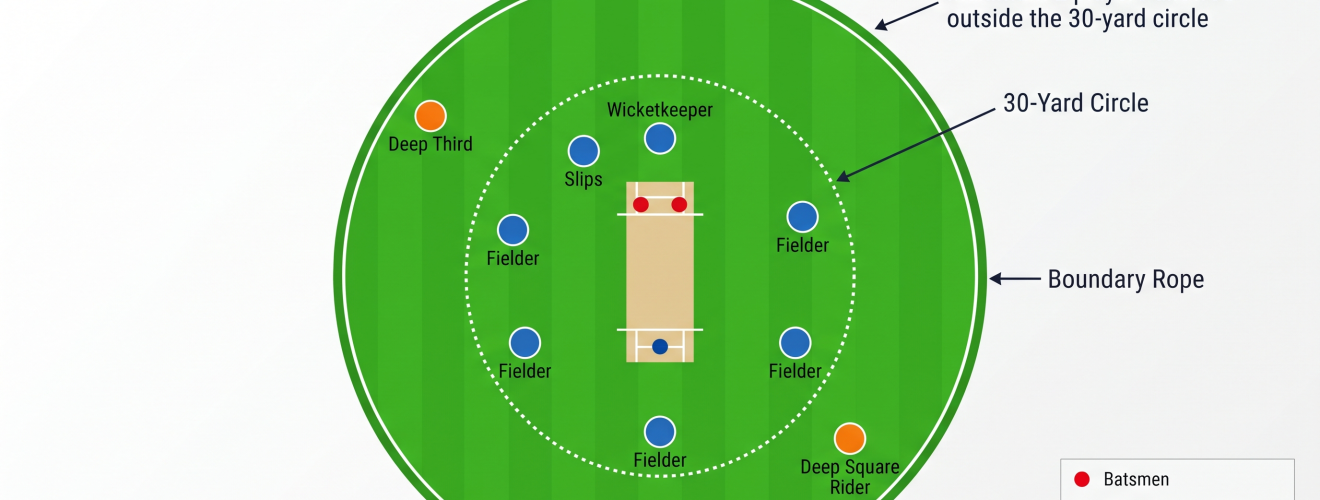
Before play begins in a One-Day International (ODI) or Twenty20 International (T20I), groundstaff mark a continuous white oval (or place flat white plastic discs) across the outfield to define the fielding restriction area, universally called the 30-yard circle. Under Clause 28.7 of the ICC Men’s ODI Playing Conditions and ICC Men’s T20I Playing Conditions, this oval is drawn using two semi-circles, each with a radius of 30 yards (27.43 meters) centered on the middle stump at either end of the pitch, connected by straight lines parallel to the pitch. (In women’s international cricket, the circle radius is 25 yards / 22.86 meters to match boundary sizes.)
As explained in the Playo Guide to Cricket Powerplay Rules, a Powerplay does not award bonus runs for boundaries. Instead, it restricts the maximum number of fielders permitted outside the 30-yard circle at the instant the bowler’s back foot lands in the delivery stride. To count as inside the ring, a fielder’s feet must be on or inside the painted line when the ball is delivered; once the ball is released, fielders may sprint outside the circle to chase it. powerplay rules in cricket
ODI Powerplay Rules: The Three Phases of a 50-Over Innings
Fielding circles were standardized globally at the 1992 World Cup and branded as “Powerplays” by the ICC in 2005. After experimenting between 2005 and 2015 with floating 5-over “bowling” and “batting” Powerplays, the ICC established the permanent three-phase structure detailed in Fielding Restrictions in ODI Cricke
1. Powerplay 1 (Overs 1 to 10 — Mandatory Opening Phase): During the first 10 overs of a 50-over innings, a maximum of two (2) fielders are permitted outside the 30-yard circle. Nine players (bowler, wicketkeeper, and seven out-fielders) must stay inside the ring.
2. Powerplay 2 (Overs 11 to 40 — Middle Overs Phase): For the next 30 overs, a maximum of four (4) fielders may stand outside the 30-yard circle, leaving five out-fielders inside the ring. Requiring five inner-ring fielders throughout the middle overs forces captains to use attacking wrist-spinners and strike seamers rather than spreading defensive boundary sweepers. powerplay rules in cricket
3. Powerplay 3 (Overs 41 to 50 — Final Death Phase): During the final 10 overs, a maximum of five (5) fielders are permitted outside the 30-yard circle, leaving four out-fielders inside the ring. That fifth boundary rider gives death bowlers crucial protection against 360-degree power-hitting.
T20I Powerplay Rules: Standard 20-Over Structure and BBL Variations
In a standard 20-over T20 International under ICC T20I Playing Conditions, the innings has two phases: Mandatory Powerplay (Overs 1 to 6): powerplay rules in cricket
During the first six overs (36 legal balls), a maximum of two (2) fielders may stand outside the 30-yard circle. Because batters have all 10 wickets intact and only two boundary riders to beat, top-order openers regularly score at 9.5 to 12.0 runs per over by lofting over the infield.
Non-Powerplay Overs (Overs 7 to 20): From the start of the 7th over through the 20th over, a maximum of five (5) fielders are permitted outside the 30-yard circle in Men’s T20Is (and four (4) fielders in Women’s T20Is).
While all ICC T20Is and the Indian Premier League (IPL) use the continuous 6-over opening Powerplay, Australia’s Big Bash League (BBL) splits its six overs into a 4-over opening Powerplay (Overs 1–4) plus a 2-over floating “Power Surge” that the batting side can call at the start of any over from Over 11 onward—forcing the bowling team back to just two boundary riders during the death overs.
Penalties for Breaking Powerplay Rules or Bowling Too Slowly
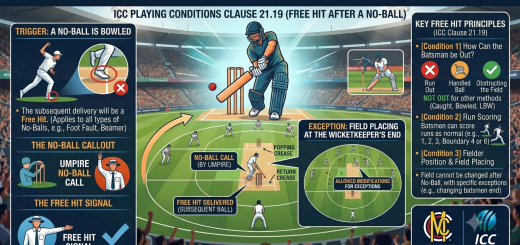
1. Fielding Restriction Violation (No-Ball + Free Hit): If a team places too many fielders outside the 30-yard circle—or more than two fielders behind square on the leg side—at the instant of delivery, the square-leg umpire calls No-Ball. The batting side receives 1 penalty run, the ball is re-bowled, and the next delivery is a Free Hit.
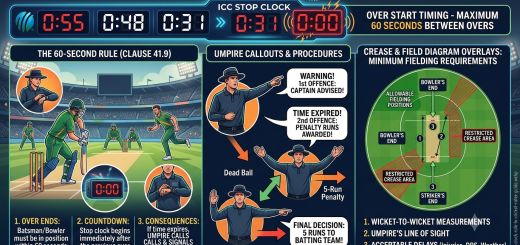
2. In-Match Slow Over-Rate Penalty: Under ICC ODI and T20I Playing Conditions (and the IPL), the bowling side must start the final over before the scheduled innings cut-off clock expires. If they fall behind the required over rate, they are penalized one fewer fielder outside the 30-yard circle (dropping from 5 boundary fielders to 4 in Men’s T20Is/ODIs, or from 4 to 3 in Women’s T20Is) for every remaining over started after the cut-off time.
Conclusion
Powerplay rules are the tactical engine of limited-overs cricket. By keeping seven out-fielders inside the 30-yard ring early, capping middle-over boundary riders, and penalizing slow over rates at the death, the ICC Playing Conditions ensure every phase of a white-ball innings demands a distinct strategy
Frequently Asked Questions (FAQs)
Do batters get double runs for hitting fours or sixes during a Powerplay? No. A four still scores 4 runs and a six still scores 6 runs. The advantage comes from having only two fielders outside the 30-yard circle, meaning any lofted shot that clears the inner ring usually races away for four.
How does the umpire signal a Powerplay? The umpire raises one arm and rotates it in a vertical circle above their head.
Why are only 2 fielders ever allowed behind square on the leg side? Under MCC Law 28.4 (introduced after the 1932–33 Bodyline series), no more than two fielders may stand behind the popping crease on the leg side at the instant of delivery in any format of cricket.
Why do Women’s T20Is allow only 4 fielders outside the circle after Over 6 instead of 5? Under ICC Women’s T20I Playing Conditions, capping post-Powerplay boundary riders at four creates more outfield gaps in overs 7–20, encouraging attacking strokeplay and higher boundary rates