Retired Hurt vs Retired Out: ScorecardRules and When a Batter Can Return
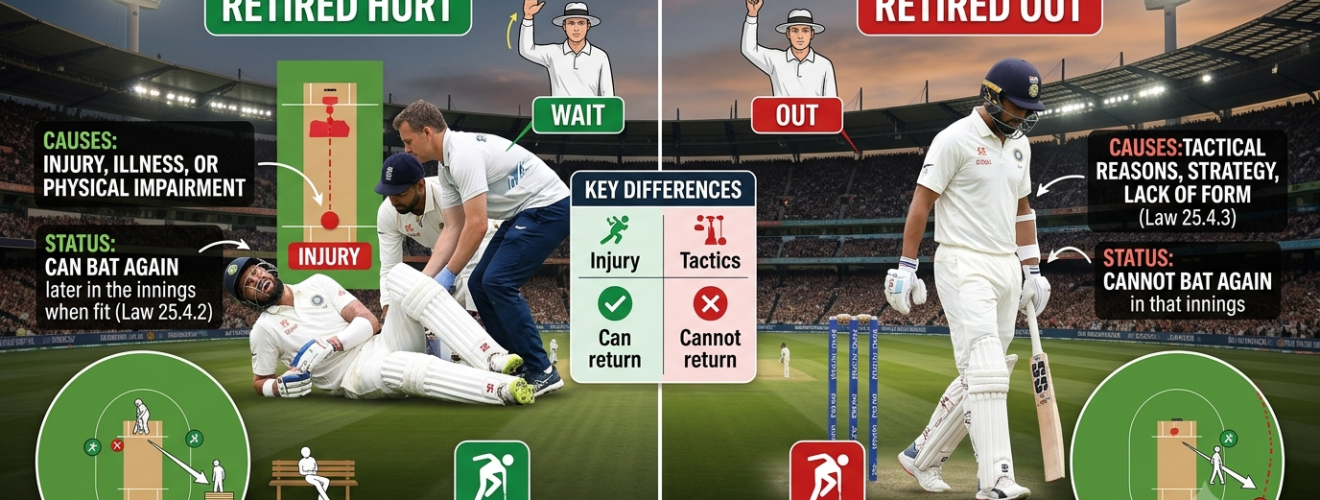
When a batter walks off the field midway through their innings without being dismissed by the bowling side, the official scorer must enter one of two very different notations on the scorecard: Retired Hurt (retired hurt — not out) or Retired Out (retired out). Whether you are following a five-day Test series, an ICC World Cup knockout, or a high- scoring franchise T20 clash, understanding retired hurt vs retired out in cricket is essential to reading the game like an experienced cricketer, umpire, or analyst. Governed officially under MCC Law 25.4 (Batter Retiring — Retired Hurt vs Retired Out)—as maintained by the MCC Law 25.4: Batter Retiring (Retired Hurt vs Retired Out) Official Text at Lord’s and implemented globally through the
International Cricket Council (ICC) Playing Conditions—this rule sits at the intersection of on-field fairness, tactical captaincy, and modern broadcast technology. retired hurt vs retired out in cricket
1. Official Definition and Core Rule Mechanics (MCC Law 25.4 (Batter Retiring — Retired Hurt vs Retired Out))
Under MCC Law 25.4, the difference between the two comes down to why the batter left the field, whether they are allowed to return to bat later in that same innings, and how the retirement affects their career batting average: 1. Retired — Not Out (Commonly called ‘Retired Hurt’ or ‘Retired Ill’ — Law 25.4.2): A batter may retire at any time when the ball is dead because of illness, injury, or any other unavoidable cause. Having informed the umpires of the reason, that batter is entitled to resume their innings at the fall of any subsequent wicket or the retirement of another batter! If they do not return before the innings ends, they are recorded on the scorecard as Retired — Not Out, which counts as a Not Out for their career batting average (meaning their runs are added without adding a dismissal!). 2. Retired — Out (Law 25.4.3): If a batter retires for any reason OTHER than illness, injury, or unavoidable cause—such as a tactical T20 retirement where a batter struggling at 20 off 22 balls walks off in the 18th over so a power-hitter can face the death overs—that batter may resume their innings ONLY with the consent of the opposing captain! When they do not return, they are recorded on the scorecard as Retired — Out, which counts as an official dismissal (one of the 10 ways to get out in cricket) and reduces their batting average just like being bowled or caught. When evaluating retired hurt vs retired out in cricket during live play, match officials follow a three-step verification sequence: (1) checking live-ball and front-foot fairness under MCC Law 20 and Law 21, (2) judging the specific spatial
or equipment trigger governing tactical retirement in t20, and (3) signaling the official decision and any penalty runs under the ICC October 2026 Playing Conditions. retired hurt vs retired out in cricket
2. How the Rule Varies Across Test, ODI, and T20 Cricket
In IPL 2022, Rajasthan Royals all-rounder Ravichandran Ashwin (having done his job as a promoted pinch-blocker with 28 off 23 balls against LSG) walked off in the 19th over to become the first batter in IPL history to tactically Retire Out so Riyan Parag could finish the innings—sparking a global wave of tactical T20 retirements by Atharva Taide, Sai Sudharsan, and international T20 captains. retired hurt vs retired out in cricket
3. Tactical Implications & Modern Officiating Updates
Even in Test cricket, tactical Retired Out has occurred once in history: in September 2001 at Colombo against Bangladesh, Sri Lanka captain Sanath Jayasuriya retired out Marvan Atapattu (201) and Mahela Jayawardene (150) to give middle-order batters batting practice! retired hurt vs retired out in cricket
Conclusion
Mastering retired hurt vs retired out in cricket under MCC Law 25.4 (Batter Retiring — Retired Hurt vs Retired Out) gives you a clear, authoritative lens on one of cricket’s essential building blocks. By combining the foundational principles of the MCC Law 25.4: Batter Retiring (Retired Hurt vs Retired Out) Official Text with the modern officiating updates in the ICC Playing Conditions, players, captains, and fans can follow every umpire signal and third-umpire replay with complete confidence. retired hurt vs retired out in cricket
Frequently Asked Questions (FAQs)
Can a batter who Retired Hurt return to the crease in the middle of an over when they feel better, without a
wicket falling?
No! Under MCC Law 25.4.2, a retired batter may resume their innings only at the fall of a wicket or the retirement of another batter. They cannot simply walk back out at drinks and tell the current batter to sit down—unless that current batter formally retires (which, if tactical, would make the current batter Retired Out!). retired hurt vs retired out in cricket
What happens if a batter Retires Hurt, and 9 wickets fall so only one healthy batter is left at the crease?
If the Retired Hurt batter is physically unable to come back out to bat when the 9th wicket falls, the team’s innings ends immediately (recorded as 9 wickets down, Innings Closed, e.g., 240/9 with the injured batter listed as Retired Hurt — Not Out), because a batter can never bat solo without a partner at the non-striker’s end. retired hurt vs retired out in cricket
Why did West Indies coach Phil Simmons/captain pull out batters via tactical ‘Retired Out’ in T20 matches?
When a top-order batter gets stuck on a slow pitch (e.g., 18 off 24 balls in the 16th over) while power-hitters like Andre Russell or Rovman Powell are waiting in the dugout with pads on, retiring the struggling batter out is identical to getting out swinging on the next ball—except it saves one precious legal ball for the incoming finisher! retired hurt vs retired out in cricket
Where can players and umpires read the official text of MCC Law 25.4 (Batter Retiring — Retired Hurt vs
Retired Out)?
The complete, authoritative text is published free of charge on the official Marylebone Cricket Club (MCC) Laws of Cricket Portal at Lord’s alongside the format-specific ICC Standard Playing Conditions. retired hurt vs retired out in cricket
How do official scorers and broadcast analysts record retired hurt vs retired out in cricket? Under MCC Law 3 (The Scorers), pavilion scorers and digital ball-by-ball analysts cross-verify every signal with the on- field umpires at the end of each over, ensuring that batting runs, extras, legal balls bowled, and bowling figures balance across the official scorecard. retired hurt vs retired out in cricket
How does does retired hurt boost batting average apply in amateur club and school cricket?
In recreational, school, and Saturday league cricket played without television third umpires or Hawk-Eye cameras, the two on-field umpires apply the core text of MCC Law 25.4 (Batter Retiring — Retired Hurt vs Retired Out) directly from the MCC Laws of Cricket, supplemented by local league regulations for over limits, fielding circles, and youth safety. retired hurt vs retired out in cricket