Hit Wicket Law Explained: WhenKnocking Off Your Own Bails Counts as Out
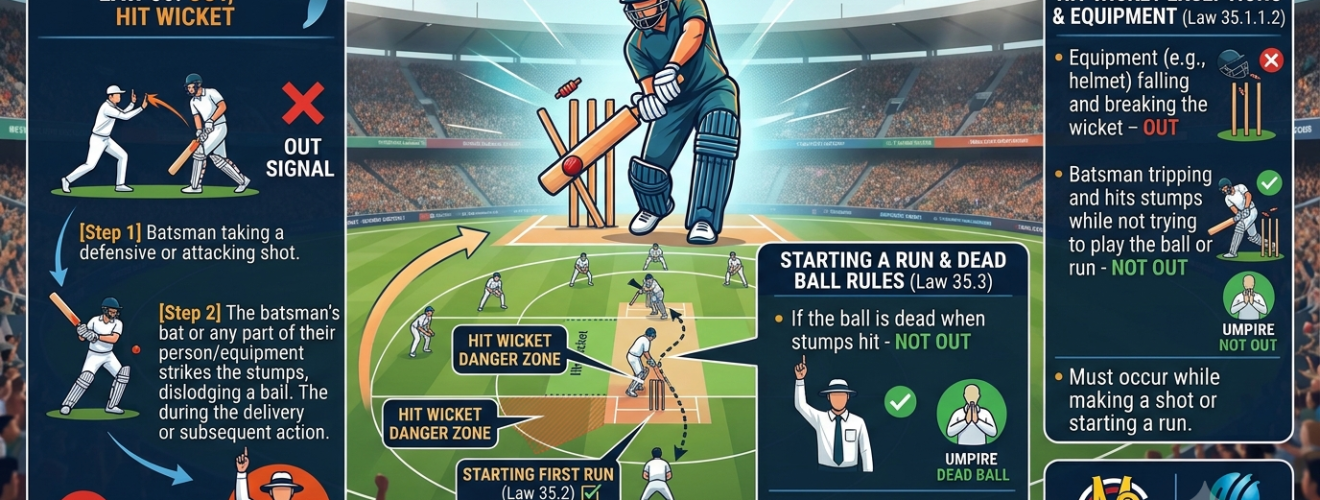
From Kevin Pietersen having his helmet knocked off his head by a Dwayne Bravo bouncer onto the bails at Headingley in 2007, to Inzamam-ul-Haq losing his balance and tumbling over his own stumps against Monty Panesar in 2006, Hit Wicket produces some of cricket’s most unforgettable replays. Whether you are following a five-day Test series, an ICC World Cup knockout, or a high-scoring franchise T20 clash, understanding hit wicket rule in cricket is essential to reading the game like an experienced cricketer, umpire, or analyst. Governed officially under MCC Law 35 (Hit Wicket) & Equipment / Starting-First-Run Rules—as maintained by the MCC Law 35: Hit Wicket Official Text (Lord’s) at Lord’s and implemented globally through the International Cricket Council (ICC) Playing Conditions—this rule sits at the intersection of on-field fairness, tactical captaincy, and modern broadcast technology. hit wicket rule in cricket
1. Official Definition and Core Rule Mechanics (MCC Law 35 (Hit Wicket) & Equipment / Starting-First-Run Rules)
Under MCC Law 35: Hit Wicket, the striker is out Hit Wicket if, after the bowler has entered their delivery stride and while the ball is in play, the striker’s wicket is broken by any part of their bat or person (which under Law 35.1.2 explicitly includes any part of their clothing or equipment even if it has become detached from their body!) in any of the following four circumstances: 1. In the course of preparing to receive or receiving a delivery; 2. In setting off for their first run immediately after playing or playing at, or failing to play at, the ball; 3. If they made no attempt to play at the ball, in setting off for their first run, provided the wicket is broken before the striker has had the opportunity to complete the action of setting off; 4. In lawfully striking the ball a second time to guard their wicket under Law 34. When evaluating hit wicket rule in cricket during live play, match officials follow a three-step verification sequence: (1) checking live-ball and front-foot fairness under MCC Law 20 and Law 21, (2) judging the specific spatial or equipment
trigger governing helmet falling on stumps, and (3) signaling the official decision and any penalty runs under the ICC October 2026 Playing Conditions. hit wicket rule in cricket
2. How the Rule Varies Across Test, ODI, and T20 Cricket
Equally important is Law 35.2 (Not out Hit wicket), which protects batters in four common scenarios: a striker is NOT OUT Hit Wicket if they break their own wicket: * While attempting to avoid being Run Out or Stumped (for example, diving back into the crease as the wicketkeeper whips the bails off or after already starting a run); * While trying to avoid a throw from a fielder; * If the bowler’s delivery was a No-Ball (though a batter CAN be out Hit Wicket off a Wide ball!); or * If the wicket is broken by the non-striker’s bat or helmet. hit wicket rule in cricket
3. Tactical Implications & Modern Officiating Updates
As clarified by the MCC in July 2023, if a batter is struck on the helmet by a bouncer, stumbles backward in shock three seconds later without attempting a run, and steps on the stumps after the action of receiving the ball has already concluded, umpires evaluate whether the action of receiving the ball was still in progress. hit wicket rule in cricket
Conclusion
Mastering hit wicket rule in cricket under MCC Law 35 (Hit Wicket) & Equipment / Starting-First-Run Rules gives you a clear, authoritative lens on one of cricket’s essential building blocks. By combining the foundational principles of the MCC Law 35: Hit Wicket Official Text (Lord’s) with the modern officiating updates in the ICC Playing Conditions, players, captains, and fans can follow every umpire signal and third-umpire replay with complete confidence. hit wicket rule in cricket
Frequently Asked Questions (FAQs)
What if a gust of wind blows the batter’s sunhat or cap off their head onto the stumps while facing a
spinner?
Under Law 35.1.2, the batter’s ‘person’ includes any item of clothing or equipment that drops from their body after the bowler enters the delivery stride. If the batter’s cap, sunglasses, towel, or broken bat blade falls onto the stumps and dislodges a bail, they are Out Hit Wicket!
What if the batter’s bat breaks in half on impact with the ball and the flying top half of the willow hits the
stumps?
They are Out Hit Wicket! Under Law 35.1.2, any detached part of the bat or protective equipment breaking the stumps during the act of receiving the ball counts as Hit Wicket.
Can a batter be out Hit Wicket if they break the stumps BEFORE the bowler enters the delivery stride?
No. Under Law 35.1.1, Hit Wicket only applies after the bowler has entered their delivery stride. If a batter accidentally taps the bails off while marking their guard during the bowler’s early run-up, the umpire calls Dead Ball, replaces the bails, and no one is out.
Where can players and umpires read the official text of MCC Law 35 (Hit Wicket) & Equipment / Starting-
First-Run Rules? The complete, authoritative text is published free of charge on the official Marylebone Cricket Club (MCC) Laws of Cricket Portal at Lord’s alongside the format-specific ICC Standard Playing Conditions.
How do official scorers and broadcast analysts record hit wicket rule in cricket? Under MCC Law 3 (The Scorers), pavilion scorers and digital ball-by-ball analysts cross-verify every signal with the on- field umpires at the end of each over, ensuring that batting runs, extras, legal balls bowled, and bowling figures balance across the official scorecard.
How does dislodging bails setting off for run apply in amateur club and school cricket?
In recreational, school, and Saturday league cricket played without television third umpires or Hawk-Eye cameras, the two on-field umpires apply the core text of MCC Law 35 (Hit Wicket) & Equipment / Starting-First-Run Rules directly from the MCC Laws of Cricket, supplemented by local league regulations for over limits, fielding circles, and youth safety. hit wicket rule in cricket
What role do captains play in managing law 35 hit wicket under pressure? Experienced international and domestic captains maintain proactive communication with the bowler’s-end and square- leg umpires between overs—checking official warning counts, over-rate cut-off timers, and crease or fielding restriction alignments so that an unforced technical error never costs the team in a tight finish. hit wicket rule in cricket