Stumped vs Run Out: How UmpiresDecide the Dismissal Type on the Scorecard
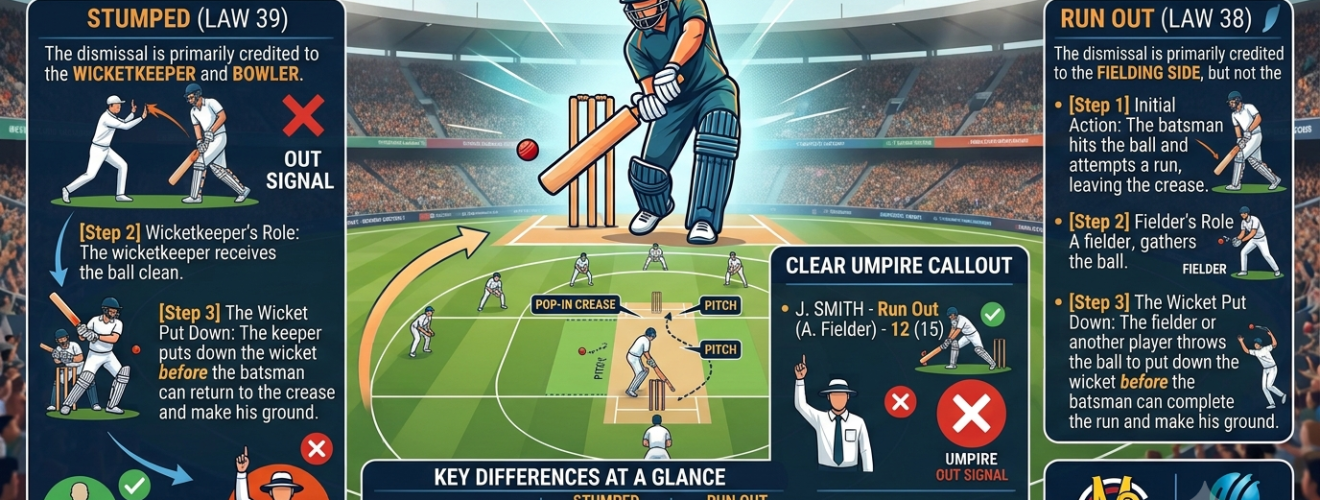
To the naked eye in the stadium stands, both dismissals look identical: the batter misses the ball, steps outside the popping crease, and the wicketkeeper whips off the bails in a flash of LED light. Why does the scoreboard sometimes record that dismissal as Stumped (st Keeper b Bowler)—giving the bowler a wicket—and other times as Run Out (run out Keeper), giving the bowler zero credit? Whether you are following a five-day Test series, an ICC World Cup knockout, or a high-scoring franchise T20 clash, understanding difference between stumped and run out is essential to reading the game like an experienced cricketer, umpire, or analyst. Governed officially under MCC Law 38 (Run Out) vs Law 39 (Stumped) — Scorecard Classification Rules—as maintained by the MCC Law 38 (Run Out) & Law 39 (Stumped) Official Comparison at Lord’s and implemented globally through the International Cricket Council (ICC) Playing Conditions—this rule sits at the intersection of on-field fairness, tactical captaincy, and modern broadcast technology. difference between stumped and run out
1. Official Definition and Core Rule Mechanics (MCC Law 38 (Run Out) vs Law 39 (Stumped) — Scorecard Classification Rules)
The difference between Stumped (MCC Law 39) and Run Out (MCC Law 38) comes down to four strict legal criteria: Was the striker attempting a run? Under Law 39.1.1, a batter can ONLY be Stumped if they are not attempting a run (for example, charging down the pitch to play a drive and missing, or overbalancing outside their crease after playing a defensive shot). If the batter misses the ball and sets off to steal a Bye (or if the non-striker calls them through for a single) and the wicketkeeper breaks the stumps, it is recorded as Run Out, not Stumped! 2. Did any fielder other than the wicketkeeper touch the ball? Under Law 39.1.1, a Stumping must be executed solely by the wicketkeeper without the intervention of any other fielder. If the ball deflects off the wicketkeeper’s gloves to first slip, and first slip tosses it back to the keeper (or throws down the stumps) while the batter is stranded down the pitch not attempting a run, it is a Run Out, not a Stumping! 3. Was the delivery a No-Ball? Under Law 39.1.1, a batter cannot be Stumped off a No-Ball.
What if the bowler bowls a front-foot No-Ball, the batter charges down the pitch and misses, and the keeper breaks the stumps? If the batter is not attempting a run, they are NOT OUT (neither Stumped nor Run Out, per Law 38.2.2.2!). They can only be Run Out off a No-Ball if they actually attempt a run! 4. Was the delivery a Wide ball? Unlike a No-Ball, a batter CAN be Stumped off a Wide ball (Law 22.9 & Law 39).
When evaluating difference between stumped and run out during live play, match officials follow a three-step verification sequence: (1) checking live-ball and front-foot fairness under MCC Law 20 and Law 21, (2) judging the specific spatial or equipment trigger governing wicketkeeper stumping on wide ball, and (3) signaling the official decision and any penalty runs under the ICC October 2026 Playing Conditions. difference between stumped and run out
2. How the Rule Varies Across Test, ODI, and T20 Cricket
Under Law 39.2, if the ball rebounds off the wicketkeeper’s person (pads, chest, or gloves—excluding a protective helmet) directly onto the stumps and dislodges the bails while the striker is out of their ground and not attempting a run, it still counts as Out Stumped! difference between stumped and run out
3. Tactical Implications & Modern Officiating Updates
This distinction matters hugely to bowlers and statisticians: Stumped credits a wicket to both the wicketkeeper AND the bowler’s figures, whereas Run Out credits only the fielder(s) and does not add to the bowler’s wicket column. difference between stumped and run out
Conclusion
Mastering difference between stumped and run out under MCC Law 38 (Run Out) vs Law 39 (Stumped) —
Scorecard Classification Rules gives you a clear, authoritative lens on one of cricket’s essential building blocks. By combining the foundational principles of the MCC Law 38 (Run Out) & Law 39 (Stumped) Official Comparison with the modern officiating updates in the ICC Playing Conditions, players, captains, and fans can follow every umpire signal and third-umpire replay with complete confidence. difference between stumped and run out
Frequently Asked Questions (FAQs)c
Can a wicketkeeper really ‘Stump’ a batter when standing 20 yards back to a fast bowler by throwing the
ball at the stumps?
Yes! Many fans assume a throw from standing back is a Run Out—and on the 2023 Lord’s scoreboard, Jonny Bairstow’s dismissal by Alex Carey off Cameron Green was initially flashed as ‘Run Out’ before the official scorers corrected it to st Carey b Green! Why? Because under Law 39, Bairstow was not attempting a run and no other fielder touched the ball. Therefore, by definition, it was a Stumping, and Cameron Green was credited with the wicket! difference between stumped and run out
Why is a batter Not Out if they charge a spinner, miss the ball by three yards, and get ‘stumped’ on a front-
foot No-Ball? Because Law 39.1.1 bans Stumping off a No-Ball, and Law 38.2.2.2 states that if No-Ball has been called, a batter cannot be Run Out unless they are attempting to run! Only if the batter sets off for a run after missing the No-Ball can the keeper run them out. difference between stumped and run out
Who holds the world record for the most Stumpings in international cricket?
India’s MS Dhoni holds the all-time world record with 195 Stumpings across Tests (38), ODIs (123), and T20Is (34), ahead of Sri Lanka’s Kumar Sangakkara (139) and Romesh Kaluwitharana (101). difference between stumped and run out
Where can players and umpires read the official text of MCC Law 38 (Run Out) vs Law 39 (Stumped) —
Scorecard Classification Rules?
The complete, authoritative text is published free of charge on the official Marylebone Cricket Club (MCC) Laws of Cricket Portal at Lord’s alongside the format-specific ICC Standard Playing Conditions.
How do official scorers and broadcast analysts record difference between stumped and run out? Under MCC Law 3 (The Scorers), pavilion scorers and digital ball-by-ball analysts cross-verify every signal with the on- field umpires at the end of each over, ensuring that batting runs, extras, legal balls bowled, and bowling figures balance across the official scorecard. difference between stumped and run out