Cricket Fielding Positions Guide:Complete Map from Slip to Cow Corner
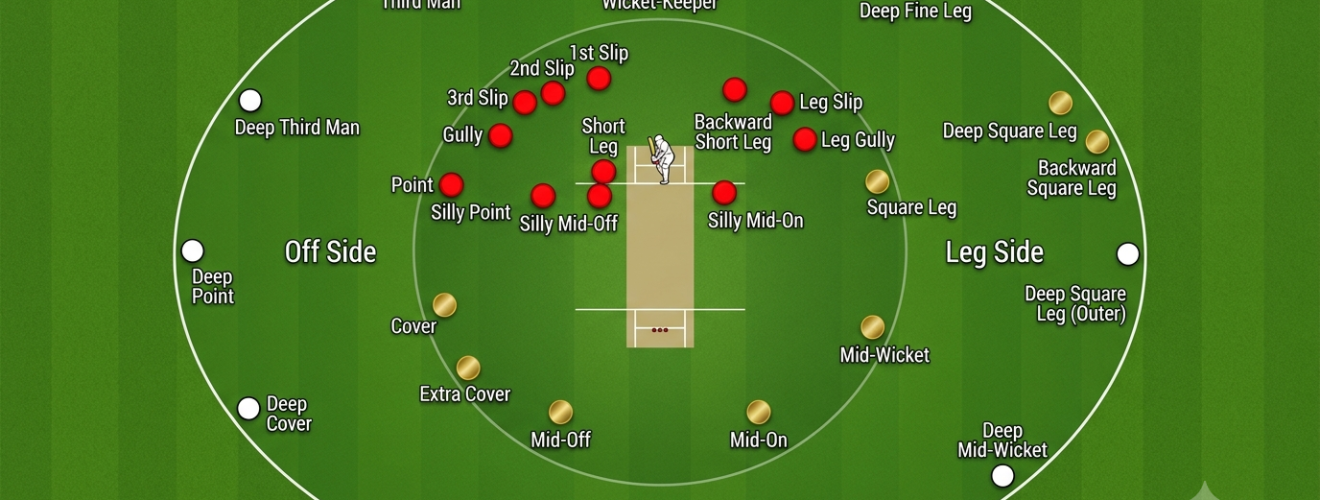
A cricket oval has more than 35 named fielding locations, yet there are only 11 players on the fielding team: the bowler, the wicketkeeper, and nine out-fielders whom the captain can position anywhere on the turf before each ball. Instead of memorizing 35 isolated names, the fastest way to master cricket fielding positions is to learn the two halves of the ground, the six directional words that modify distance and angle, and the three concentric rings explained in the Sportplan Cricket Fielding Positions Guide.
Step 1: Off Side vs. Leg Side (On Side)
Every fielding position is named from the perspective of the striker (the batter facing the bowler). Imagine a line running down the center of the pitch through both sets of stumps, dividing the oval into two halves: The Off Side: The half of the ground in front of the batter’s chest and bat blade (to the right-hand side of a right-
handed batter looking toward the bowler, or the left-hand side of a left-handed batter). The Leg Side (On Side): The half of the ground behind the batter’s legs (to the left-hand side of a right-handed
batter, or the right-hand side of a left-handed batter). Because these sides are anchored to the batter’s stance, the Off Side and Leg Side mirror across every time a right- hander and a left-hander rotate the strike.Cricket fielding positions are very important in cricket. Every player should understand all cricket fielding positions to improve their game. From Slip to Fine Leg, every position has a special role in stopping runs and taking wickets. Learning the right fielding positions helps a team perform better and win matches.
Step 2: The Six Directional Modifiers (Distance and Angle)
Nearly every cricket fielding name pairs a base region (Point, Cover, Mid-off, Midwicket, Leg) with one of six modifiers indicating distance from the bat and angle from the crease:
- Silly / Short (2 to 10 Yards): Helmeted close catchers standing right beside the pitch to pouch pop-ups off bat and
pad (Silly Point, Silly Mid-off, Short Leg). - Mid / Standard (20 to 30 Yards): The single-saving inner ring around the 30-yard circle (Point, Cover, Mid-off, Mid-
on, Midwicket). - Deep / Long (65 to 85 Yards on the Boundary): Patrolling the rope to stop fours and catch sixes. Straight positions
use Long (Long-off, Long-on); wider positions use Deep (Deep Point, Deep Cover, Deep Midwicket, Deep Square
Leg). - Square (90° Right Angle to the Crease): Directly inline with the popping crease (Point on the off side; Square Leg
by the leg-side umpire). - Backward (Behind the 90° Line): Shifted 15–25 degrees behind the popping crease (Backward Point, Backward
Square Leg).
- Fine (Narrow 15°–30° Angle Behind the Wicket): Close to the line of the stumps behind the keeper (Fine Leg, Short
Third Man).
Step 3: The Three Concentric Fielding Rings
As detailed in the Gray-Nicolls Guide to Cricket Fielding Positions and Zee Sports Field Map Guide, captains arrange their nine out-fielders across three functional rings:
Ring 1: Close Catchers Around the Bat (Attacking Wicket-Takers) Wicketkeeper: Crouches behind the stumps; stands 15–22 yards back to fast bowlers and right up to the stumps for spinners.
First to Fourth Slip: Diagonal cordon on the off side beside the keeper to catch thin outside edges.
Gully: Stands squarer than the slips (toward point) to catch hard-hit thick edges off cuts and drives.
Leg Slip & Leg Gully: Mirror image of slip and gully behind the batter’s pads on the leg side. Silly Point & Short Leg (Bat-Pad): Stationed 2–3 yards from the bat on the off side (Silly Point) and leg side (Short
Leg) to catch balls spitting off the inside edge and boot against spin.Cricket fielding positions are very important in cricket. Every player should understand all cricket fielding positions to improve their game. From Slip to Fine Leg, every position has a special role in stopping runs and taking wickets. Learning the right fielding positions helps a team perform better and win matches.
Ring 2: The 30-Yard Inner Ring (Single-Saving & Run-Out Ring) Short Third Man & Short Fine Leg: Inside the circle at 45 degrees behind the wicket on the off and leg sides. Backward Point & Point: Square of the wicket on the off side to cut off square cuts. Cover & Extra Cover: Between Point (90°) and Mid-off (20°) to stop the front-foot cover drive. Mid-off & Mid-on: Either side of the bowler’s run-up to stop straight drives.
Midwicket & Square Leg: Key leg-side inner-ring spots cutting off flicks, pulls, and sweeps.Cricket fielding positions are very important in cricket. Every player should understand all cricket fielding positions to improve their game. From Slip to Fine Leg, every position has a special role in stopping runs and taking wickets. Learning the right fielding positions helps a team perform better and win matches.
Ring 3: The Boundary Outfielders (Four-Savers & Catchers in the Deep) Third Man & Fine Leg: On the boundary behind the slips (off side) and behind the pads (leg side). Deep Point & Deep Cover (Sweeper): Patrolling the square and wide off-side boundary. Long-off & Long-on: Straight down the ground behind the bowler on the off and leg sides. Cow Corner, Deep Midwicket, & Deep Square Leg: Guarding the leg-side boundary arc against slog-sweeps and pull shots (Cow Corner sits between Long-on and Deep Midwicket).Cricket fielding positions are very important in cricket. Every player should understand all cricket fielding positions to improve their game. From Slip to Fine Leg, every position has a special role in stopping runs and taking wickets. Learning the right fielding positions helps a team perform better and win matches.
Conclusion
Once you orient Off Side vs. Leg Side from the batter’s stance and apply the six distance-and-angle modifiers, the geometry of a cricket field becomes second nature. Watch where the captain shifts Point, Mid-off, and Deep Midwicket before the bowler runs in—those three placements telegraph the bowler’s exact plan.Cricket fielding positions are very important in cricket. Every player should understand all cricket fielding positions to improve their game. From Slip to Fine Leg, every position has a special role in stopping runs and taking wickets. Learning the right fielding positions helps a team perform better and win matches.
Frequently Asked Questions (FAQs)
What does a “6–3 field” or “5–4 field” mean? The first number (6) always indicates the number of out-fielders on the Off Side, and the second number (3) indicates the number of out-fielders on the Leg Side (totaling 9 out-fielders, excluding the bowler and wicketkeeper). What is a “Fly Slip” in cricket?
A Fly Slip stands deeper than the normal slip cordon—roughly 25–35 yards behind the batter between the slips and third man—to catch upper-cuts and top-edges on bouncy pitches. Where do a team’s best fielders usually stand? Agile inner-ring stoppers with elite throwing arms usually patrol Point, Backward Point, and Cover during the early and middle overs, then move out to Long-off, Long-on, and Deep Midwicket in the T20 death overs. Are there rules on where a fielder cannot stand? Yes. Under MCC Law 28.1, no fielder may step onto or extend over the pitch itself before the ball reaches the striker; under Law 28.4, no more than two fielders may stand behind the popping crease on the leg side.Cricket fielding positions are very important in cricket. Every player should understand all cricket fielding positions to improve their game. From Slip to Fine Leg, every position has a special role in stopping runs and taking wickets. Learning the right fielding positions helps a team perform better and win matches.