All 10 Ways a Batter Can Be DismissedUnder the MCC Laws of Cricket
While over 98% of wickets in cricket fall Caught, Bowled, LBW, Run Out, or Stumped, rare incidents—like Angelo Mathews’s broken helmet strap at the 2023 World Cup—bring the full rulebook into focus.
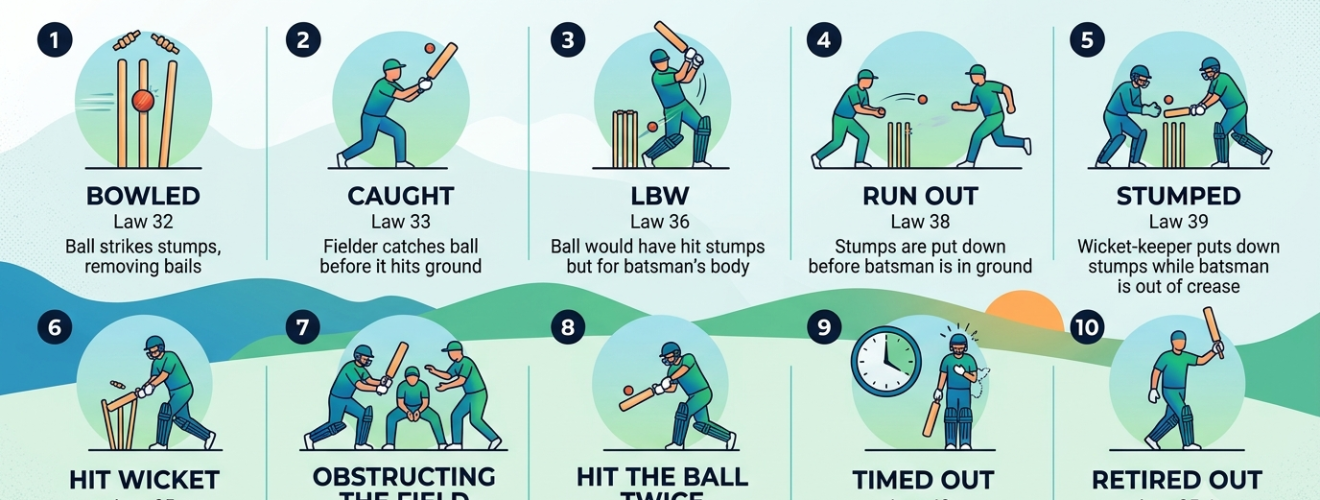
Under the official MCC Laws of Cricket (2017 Code, updated through the October 2026 edition), there are exactly 10 ways to get out in cricket: nine primary dismissals under Laws 32 to 40, plus Retired Out under Law 25.4.3. (The old 11th mode, Handled the Ball, was abolished as a separate law in 2017 and merged into Obstructing the Field.) Here is how all 10 dismissals work, which ones credit the bowler, and which apply on a No-Ball, Wide, or Free Hit. ways-to-get-out-in-cricket
The Five Common Dismissals (Over 98% of All Wickets)
- Bowled (MCC Law 32)
A striker is out Bowled if their wicket is put down by a fair delivery from the bowler—dislodging at least one bail completely (or knocking a stump out of the turf). It still counts as Bowled even if the ball deflects off the striker’s bat, pads, or body onto the stumps, provided no other player or umpire touches it in between. Under Law 32.2, Bowled takes precedence over all other dismissals: if a batter inside-edges the ball onto the stumps and it rebounds to the wicketkeeper, it is Bowled, not Caught. * Credited to Bowler? Yes. - Caught (MCC Law 33)
Nearly 60% of all international wickets fall Caught. The striker is out if a fair delivery touches their bat (or the hand/glove holding the bat while in contact with the bat) and is held completely under control by a fielder before touching the ground. Under Law 19.5, a fielder jumping from outside the boundary rope must either land back inside the field or parry the ball back into play while airborne without touching the rope or ground beyond. * Credited to Bowler? Yes. - Leg Before Wicket — LBW (MCC Law 36)
Under MCC Law 36, the striker is out LBW if a fair delivery pitches in line with the stumps or on the off side (or hits on the full), strikes any part of the batter’s body before touching the bat (in line with the stumps, or outside off if offering no shot), and would have gone on to hit the wickets. * Credited to Bowler? Yes. - Run Out (MCC Law 38)
Either batter is Run Out if, while the ball is in play, their wicket is fairly put down by the fielding side while no part of the batter’s bat or body is grounded behind the popping crease. Since October 2022, running out a non-striker who backs up out of their ground before the bowler releases the ball is governed directly by Law 38.3 as a standard, legitimate Run Out rather than “Unfair Play.” * Credited to Bowler? No. - Stumped (MCC Law 39)
The striker is out Stumped if, while receiving a ball that is not a No-Ball, they step outside their popping crease, are not attempting a run, and the wicketkeeper puts down the wicket without another fielder touching the ball. Crucially, abatter can be Stumped off a Wide ball; if they set off to attempt a run, however, the dismissal is recorded as Run Out. Credited to Bowler? Yes. ways-to-get-out-in-cricket
The Five Rare Dismissals (Under 2% of All Wickets)
- Hit Wicket (MCC Law 35)
Under MCC Law 35: Hit Wicket, the striker is out Hit Wicket if, after the bowler enters their delivery stride and while the ball is in play, the striker breaks their own wicket with their bat, body, clothing, or equipment (such as stepping back onto the stumps, knocking the bails with a follow-through, or having a helmet fall onto the stumps)—or while setting off immediately for their first run. Breaking the stumps while diving to avoid a fielder’s throw is Not Out Hit Wicket. * Credited to Bowler? Yes. - Obstructing the Field (MCC Law 37 — Incorporates “Handled the Ball”)
Either batter is out under Law 37 if they wilfully obstruct or distract the fielding side by word or action while the ball is in play—including intentionally veering into the line of a throw or wilfully touching the ball with a hand not holding the bat without a fielder’s consent. Accidental contact or shielding against injury is Not Out. * Credited to Bowler? No. - Hit the Ball Twice (MCC Law 34)
If the ball strikes the batter’s bat or person and rolls toward the stumps, Law 34 permits the batter to hit the ball a second time using only their bat strictly to guard their own wicket. If they wilfully hit the ball a second time for any other reason (such as trying to score runs or preventing a catch), they are out Hit the Ball Twice. * Credited to Bowler? No. - Timed Out (MCC Law 40)
Under MCC Law 40: Timed Out and ICC Playing Conditions, an incoming batter must be ready to face the next ball within 3 minutes in Tests, 2 minutes in ODIs, and 90 seconds in T20Is of a wicket falling. As confirmed in the MCC Statement on Timed Out, Sri Lanka’s Angelo Mathews became the first international player dismissed Timed Out against Bangladesh at the 2023 World Cup when his helmet strap broke after the 2-minute window had elapsed. * Credited to Bowler? No. - Retired Out (MCC Law 25.4.3)
As detailed in the 2026 Guide to All 10 Modes of Dismissal, a batter retiring due to injury or illness is Retired — Not Out (Law 25.4.2) and may return at the fall of a wicket. If a batter retires for any tactical reason (Law 25.4.3), they are recorded as Retired — Out, which counts as a dismissal for batting averages and prevents them from returning without the opposing captain’s consent. * Credited to Bowler? No.ways-to-get-out-in-cricket
Conclusion
Mastering all 10 modes of dismissal under the MCC Laws of Cricket clarifies every scorecard entry in the sport: Bowled, Caught, LBW, Stumped, and Hit Wicket credit the bowler’s tally, while Run Out, Obstructing the Field, Hit the Ball Twice, Timed Out, and Retired Out enforce fairness during running and between deliveries. ways-to-get-out-in-cricket
Frequently Asked Questions (FAQs)
Why is “Handled the Ball” no longer the 11th way to get out? In October 2017, the MCC merged Handled the Ball directly into Law 37 (Obstructing the Field). Which dismissals can still happen off a No-Ball or a Free Hit? Only three: Run Out (Law 38), Obstructing the Field (Law 37), and Hit the Ball Twice (Law 34).
Which dismissals can happen off a Wide ball? Four: Stumped, Run Out, Hit Wicket (if stepping onto the stumps while reaching for the Wide), and Obstructing the Field. Can an umpire give a batter out without an appeal? Under MCC Law 31.1, an umpire cannot give a batter out unless the fielding team appeals (“Howzat!”) before the bowler starts their next run-up, though batters routinely walk off voluntarily when cleanly Bowled or Caught.