No-Ball Rules in Cricket: Front Foot,Waist-High Full Tosses, and Free Hits
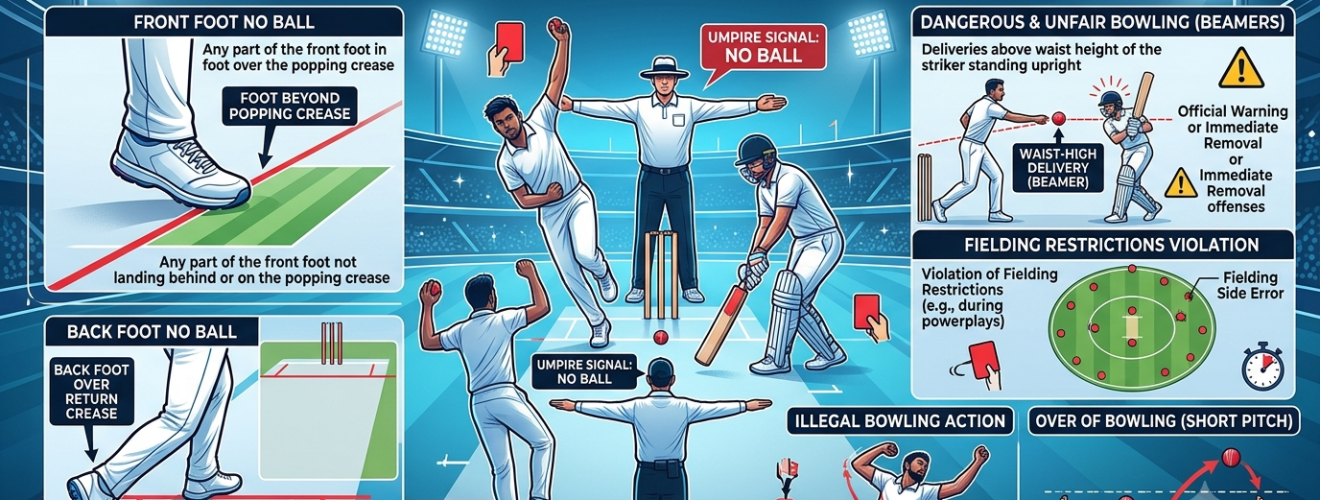
A single centimetre of boot leather sliding past the painted white popping crease can turn a match-winning wicket into a free six on the very next ball. Whether you are following a five-day Test series, an ICC World Cup knockout, or a high- scoring franchise T20 clash, understanding no ball rules in cricket is essential to reading the game like an experienced cricketer, umpire, or analyst.Governed officially under MCC Law 21 (No Ball) & ICC Playing Conditions Clause 21—as maintained by the MCC Law 21: No Ball Official Text (Lord’s) at Lord’s and implemented globally through the International Cricket Council (ICC) Playing Conditions—this rule sits at the intersection of on-field fairness, tactical captaincy, and modern broadcast
technology. no-ball-rules-in-cricket
- Official Definition and Core Rule Mechanics (MCC Law 21 (No Ball) & ICC Playing Conditions Clause 21)Under Law 21.5, in the delivery stride some part of the bowler’s front foot—whether grounded or raised—must land behind the back edge of the popping crease, and the back foot must land within and not touching the return crease. Additionally, under Law 41.7, any non-pitching delivery (full toss) that passes or would have passed above the striker’s waist height when standing upright at the popping crease is an automatic No-Ball. When evaluating no ball rules in cricket during live play, match officials follow a three-step verification sequence: (1) checking live-ball and front-foot fairness under MCC Law 20 and Law 21, (2) judging the specific spatial or equipment trigger governing free hit rules, and (3) signaling the official decision and any penalty runs under the ICC October 2026 Playing Conditions.
- How the Rule Varies Across Test, ODI, and T20 Cricket
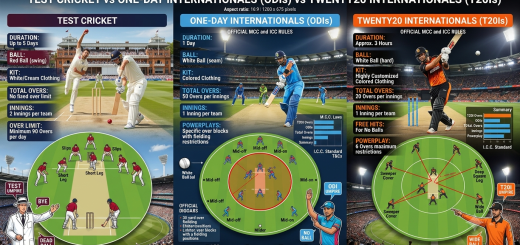
In Test cricket, a No-Ball awards 1 penalty run and requires the ball to be re-bowled, but does not trigger a Free Hit unless specified by tournament conditions. In ODI and T20I cricket under ICC Playing Conditions, every mode of No- Ball—front foot, back foot, waist-high full toss, over-the-head bouncer limit violation, or fielding circle violation— triggers a Free Hit on the very next delivery.
- Tactical Implications & Modern Officiating Updates
Since 2020, ICC international matches and premier T20 leagues use automated third-umpire side-on 300fps cameras to check every single front-foot landing within three seconds, eliminating missed on-field calls. no-ball-rules-in-cricket
Conclusion
Mastering no ball rules in cricket under MCC Law 21 (No Ball) & ICC Playing Conditions Clause 21 gives you a clear, authoritative lens on one of cricket’s essential building blocks. By combining the foundational principles of the MCC Law 21: No Ball Official Text (Lord’s) with the modern officiating updates in the ICC Playing Conditions, players, captains, and fans can follow every umpire signal and third-umpire replay with complete confidence. no-ball-rules-in-cricket
Frequently Asked Questions (FAQs)
Can a batter be out on a No-Ball? Only in three ways: Run Out (Law 38), Obstructing the Field (Law 37), and Hit the Ball Twice (Law 34). A batter cannot be Bowled, Caught, LBW, Stumped, or Hit Wicket off a No-Ball. What happens if a bowler bowls two waist-high full tosses in the same innings?
Under Law 41.7, the first dangerous waist-high full toss results in a No-Ball and a first and final warning. A second waist-high full toss by the same bowler in that innings results in immediate suspension from bowling for the remainder of the innings. Does a No-Ball count as a ball faced by the batter? Yes! Unlike a Wide, a No-Ball does count as a ball faced in the batter’s individual score and strike-rate statistics, and any runs scored off the bat are credited to the batter while the 1-run penalty goes to Extras. Where can players and umpires read the official text of MCC Law 21 (No Ball) & ICC Playing Conditions Clause 21? The complete, authoritative text is published free of charge on the official Marylebone Cricket Club (MCC) Laws of Cricket Portal at Lord’s alongside the format-specific ICC Standard Playing Conditions. How do official scorers and broadcast analysts record no ball rules in cricket? Under MCC Law 3 (The Scorers), pavilion scorers and digital ball-by-ball analysts cross-verify every signal with the on- field umpires at the end of each over, ensuring that batting runs, extras, legal balls bowled, and bowling figures balance across the official scorecard. How does front foot no ball apply in amateur club and school cricket? In recreational, school, and Saturday league cricket played without television third umpires or Hawk-Eye cameras, the two on-field umpires apply the core text of MCC Law 21 (No Ball) & ICC Playing Conditions Clause 21 directly from the MCC Laws of Cricket, supplemented by local league regulations for over limits, fielding circles, and youth safety. What role do captains play in managing waist high beamer rule under pressure? Experienced international and domestic captains maintain proactive communication with the bowler’s-end and square-
leg umpires between overs—checking official warning counts, over-rate cut-off timers, and crease or fielding restriction alignments so that an unforced technical error never costs the team in a tight finish. How have the 2022–2026 MCC and ICC rule updates refined no ball rules in cricket? Between the October 2022 MCC Code revision and the October 2026 ICC Playing Conditions update, lawmakers streamlined on-field officiating by clarifying dead-ball boundaries, modernizing third-umpire camera tracking, and aligning pace-of-play and fairness penalties across red-ball and white-ball formats. How do broadcast graphics and Hawk-Eye overlays illustrate no ball rules in cricket for television viewers? Modern international and franchise broadcasts pair live stump-camera feeds with real-time graphic overlays— highlighting crease markings, 30-yard restriction rings, ball-tracking trajectories, and official third-umpire timer clocks so spectators in the stadium and at home can verify every step of MCC Law 21 (No Ball) & ICC Playing Conditions
Clause 21 in real time. What are the most common misconceptions fans have about no ball rules in cricket?
The most frequent misconception is assuming that a single universal rule applies identically across all formats without checking whether the match is played under standard MCC Laws or format-specific ICC Playing Conditions (where white-ball fielding restrictions, Free Hits, and electronic stop clocks modify the baseline rule). no-ball-rules-in-cricket