Byes, Leg Byes, Wides, and No-Balls:How Extras Count Against Bowler and Team
In the 1999 World Cup match between Pakistan and Scotland at Chester-le-Street, ‘Extras’ scored 59 runs—outscoring every individual batter on the field except Yousuf Youhana! Understanding how the five types of Extras (called ‘Sundries’ in Australia) work is essential to reading any cricket scorecard. Whether you are following a five-day Test series, an ICC World Cup knockout, or a high-scoring franchise T20 clash, understanding extras in cricket explained is essential to reading the game like an experienced cricketer, umpire, or analyst. Governed officially under MCC Law 21 (No Ball), Law 22 (Wide), Law 23 (Bye and Leg Bye) & Scorecard Accounting— as maintained by the Extras in Cricket Explained: Byes, Leg Byes, Wides, No-Balls & Penalty Runs at Lord’s and implemented globally through the International Cricket Council (ICC) Playing Conditions—this rule sits at the intersection of on-field fairness, tactical captaincy, and modern broadcast technology. extras in cricket explained
Official Definition and Core Rule Mechanics (MCC Law 21 (No Ball), Law 22 (Wide), Law 23 (Bye and Leg Bye) & Scorecard Accounting)
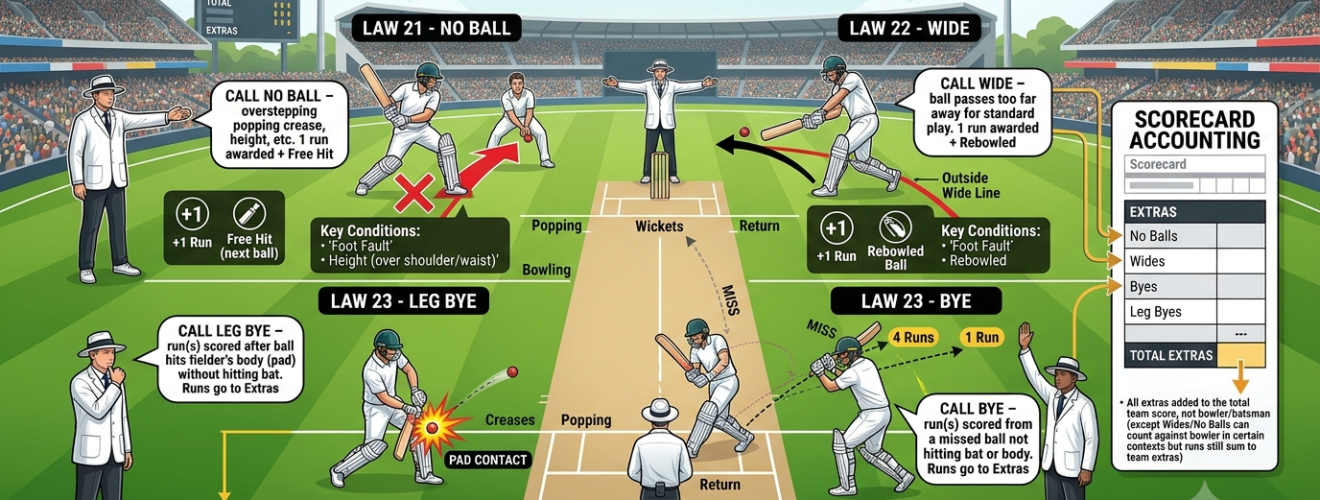
Every run added to a batting team’s total comes from one of two sources: Runs off the Bat (credited to a specific batter) or Extras. There are five categories of Extras under the MCC Laws: 1. Byes (b — Law 23.1): Runs scored when a fair delivery (not a No-Ball or Wide) passes the striker without touching their bat or body, and the batters run or the ball crosses the boundary. 2. Leg Byes (lb — Law 23.2): Runs scored when a fair delivery strikes any part of the striker’s body or protective gear (except the hand holding the bat)—PROVIDED that the striker was either (a)\ attempting to play the ball with their bat, or (b) trying to avoid being hit by the ball. If the batter deliberately kicks or pads the ball away without offering a shot or evading injury, the umpire calls Dead Ball on completion of the run and disallows the Leg Bye! 3. Wides (w — Law 22): 1 penalty run + re-bowl + any additional runs run by the batters (or 4 if it reaches the boundary = 5 Wides total). 4. No-Balls (nb — Law 21): 1 penalty run + re-bowl (+ any runs off the bat go to the batter; any runs not off the bat go to No-Ball extras). 5. Penalty Runs (p — Law 41/42/28): 5 runs awarded for
helmet hits, ball tampering, fake fielding, or stop-clock breaches. When evaluating extras in cricket explained during live play, match officials follow a three-step verification sequence: (1) checking live-ball and front-foot fairness under MCC Law 20 and Law 21, (2) judging the specific spatial or equipment trigger governing do wides count as balls faced, and (3) signaling the official decision and any penalty runs under the ICC October 2026 Playing Conditions. extras in cricket explained
2. How the Rule Varies Across Test, ODI, and T20 Cricket
Knowing how each Extra affects Batter Balls Faced, Bowler Runs Conceded, and Maiden Overs separates
experienced scorers from casual viewers. extras in cricket explained
3. Tactical Implications & Modern Officiating Updates
For example, if a bowler bowls 6 legal balls that all miss the bat and the batters run 4 Byes and 2 Leg Byes, that over is still recorded as a Maiden Over for the bowler (1-1-0-0) because zero runs were charged against the bowler! extras in cricket explained
Conclusion
Mastering extras in cricket explained under MCC Law 21 (No Ball), Law 22 (Wide), Law 23 (Bye and Leg Bye) & Scorecard Accounting gives you a clear, authoritative lens on one of cricket’s essential building blocks. By combining the foundational principles of the Extras in Cricket Explained: Byes, Leg Byes, Wides, No-Balls & Penalty Runs with the modern officiating updates in the ICC Playing Conditions, players, captains, and fans can follow every umpire signal and third-umpire replay with complete confidence. extras in cricket explained
Frequently Asked Questions (FAQs)
Why is a Leg Bye disallowed if a batter pads up to a spinner without offering a shot?
Under MCC Law 23.2.1, a Leg Bye is only legal if the striker either made a genuine attempt to hit the ball with their bat OR tried to avoid being hit by the ball. If a batter thrusts their pad out defensively with the bat tucked behind it and the ball deflects to fine leg, the batters may run, but as soon as the ball becomes dead the bowler’s-end umpire signals Dead Ball, returns the batters to their original ends, and awards zero runs. extras in cricket explained
What happens if a batter hits a boundary Four off a No-Ball?
The team total increases by 5 runs: the batter is credited with 4 runs (and 1 ball faced), and 1 No-Ball extra is added to the Extras column. All 5 runs are charged against the bowler’s figures, and the ball must be re-bowled. extras in cricket explained
What is the highest number of Extras ever conceded in a Test or ODI innings?
In Test cricket, Pakistan conceded 76 Extras (35 Byes, 26 Leg Byes, 0 Wides, 15 No-Balls) against India in Bengaluru in December 2007. In ODI cricket, Pakistan conceded 59 Extras twice (vs West Indies at Brisbane 1989 and vs Scotland at Chester-le-Street 1999). extras in cricket explained
Where can players and umpires read the official text of MCC Law 21 (No Ball), Law 22 (Wide), Law 23 (Bye and Leg Bye) & Scorecard Accounting? The complete, authoritative text is published free of charge on the official Marylebone Cricket Club (MCC) Laws of Cricket Portal at Lord’s alongside the format-specific ICC Standard Playing Conditions.
How do official scorers and broadcast analysts record extras in cricket explained? Under MCC Law 3 (The Scorers), pavilion scorers and digital ball-by-ball analysts cross-verify every signal with the on- field umpires at the end of each over, ensuring that batting runs, extras, legal balls bowled, and bowling figures balance across the official scorecard. extras in cricket explained
How does leg bye rule shot offered apply in amateur club and school cricket?
In recreational, school, and Saturday league cricket played without television third umpires or Hawk-Eye cameras, the two on-field umpires apply the core text of MCC Law 21 (No Ball), Law 22 (Wide), Law 23 (Bye and Leg Bye) & Scorecard Accounting directly from the MCC Laws of Cricket, supplemented by local league regulations for over limits, fielding circles, and youth safety.
What role do captains play in managing extras in team total vs bowler figures under pressure? Experienced international and domestic captains maintain proactive communication with the bowler’s-end and square- leg umpires between overs—checking official warning counts, over-rate cut-off timers, and crease or fielding restriction alignments so that an unforced technical error never costs the team in a tight finish. extras in cricket explained